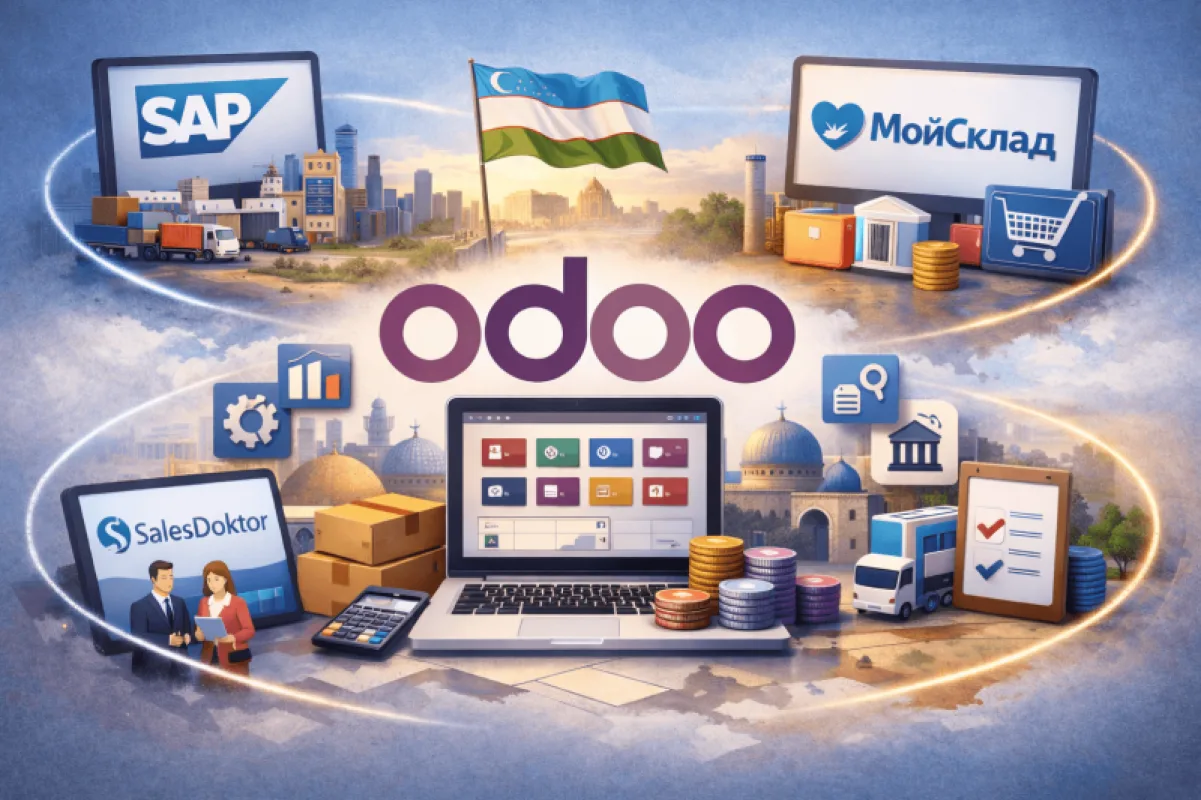
In Uzbekistan, many companies are still not managed digitally, or they are “partly digital” but fragmented across different systems. This article looks at that exact reality and compares SAP, Moysklad, Salesdoktor, and Odoo to help you understand which option fits your business best.
Keywords: ERP comparison Uzbekistan, choosing an ERP system, SAP vs Moysklad vs Salesdoktor, Odoo or Moysklad, ERP implementation, business digitalization.
Quick answer
Digitalization in Uzbekistan is not yet widespread: small and medium-sized businesses (SMEs) make up more than 90% of all businesses and generate 75% of employment. At the same time, more than 80% of SMEs still keep accounting and inventory manually or in Excel.
Odoo: 13M+ users, 7,000 new customers per month and 40% annual growth; grows module-by-module and integrates all departments in a single database.
Moysklad: a cloud SaaS solution focused on sales and inventory; offers inventory, sales, finance, and basic CRM features in one platform.
Salesdoktor: a B2B SaaS founded in Tashkent in 2015; focused on automating sales processes (strong focus on partner-network processes).
SAP: a global ERP giant with over 50 years of history; a world leader with 400,000+ customers. Designed for complex supply chains and compliance requirements, but implementation is expensive and takes time.
Conclusion: if your company is not fully digital yet, module-based solutions like Odoo or Moysklad can bring order faster. If you mainly focus on sales processes, Salesdoktor can fit (but with some “buts”). For very large enterprises with complex processes, SAP is usually chosen. In any case, the key success factor is correct implementation.
1. Fragmented IT: businesses with no digitalization or partial digitalization
In many Uzbekistan companies, the picture looks the same:
- Finance and accounting in a separate system (1C or another accounting solution)
- Sales and customer base in another CRM or Telegram (tools like amoCRM/Kommo)
- Warehouse and inventory in Excel or a separate app
- Internal workflows in Telegram, phone calls, and processes tied to an “admin girl’s notebook”
- Reporting: “we’ll compile it” (meaning delayed and manually consolidated)
As a result, the same data is duplicated in several places, numbers don’t match, and managers don’t have real-time control. According to recent research, more than 80% of SMEs still keep accounting and inventory manually.
Why ERP?
An ERP system unifies finance, sales, warehouse, HR and other processes in one database. This is not just software, it is business systemization:
- Data is not duplicated
- Processes are automated
- Managers can see the real-time situation
2. Odoo: a module-by-module platform
Key facts
- 13M+ users: public Odoo figures mention 13M+ users, 7,000 new customers per month, and 40% annual growth.
- Modular: CRM, sales, warehouse, finance, website/e-commerce, HR, manufacturing, all in one platform.
- Flexible: expands step-by-step from small to mid-size; works for large companies too.
Why Odoo fits Uzbekistan
- Removes fragmentation: one system instead of many separate tools.
- Implemented in stages: start with sales/CRM, then warehouse/finance, then HR/manufacturing.
- Local integration: easier to integrate with banks, tax and fiscal systems (through local partners).
- Big community and ecosystem: open-source approach and a large global community.
3. Moysklad: cloud sales and inventory system
Key facts
- Cloud-based, 24/7: full SaaS, accessible from any device via the internet.
- Sales + warehouse + finance + CRM: manages inventory, sales orders, cash desk and finance, and provides basic CRM.
- Integrations: connects with marketplaces, 1C, online cash registers, logistics companies, and CMS.
Who it’s for
- Retail and wholesale businesses with multiple stores and warehouses.
- Online stores working with e-commerce and marketplaces.
- Small manufacturing and service businesses.
Strengths and weaknesses
- Strengths: quick start, strong focus on inventory and sales, cloud approach, integrations.
- Weaknesses: local accounting/tax modules are limited for Uzbekistan; fewer capabilities for HR and manufacturing.
4. Salesdoktor: SaaS for distributors and sales processes
Key facts
- Known as a solution focused on distribution and field-sales processes in Central Asia.
- Distribution workflows: automates sales agents’ work, collects orders, tracks stock balances, offers route planning.
- Mobile and cloud: often built for mobile agents; data stored in the cloud and updated in real time.
Who it’s for
- Distributors and dealer networks (agent control, order collection, delivery, accounts receivable).
- Wholesale businesses with many dealers.
Strengths and weaknesses
- Strengths: deep focus on distribution workflows, convenient for mobile agents, tailored to local market needs.
- Weaknesses: limited as a general ERP; narrower capabilities for finance, HR, manufacturing, and e-commerce.
5. SAP: a corporate giant
Key facts
- Over 50 years of history.
- 400,000+ customers: one of the largest ERP providers globally.
- Enterprise processes: designed for large companies/holdings with complex supply chains, compliance, international reporting, and integration requirements.
Strengths and weaknesses
- Strengths: strong compliance and best practices for large corporations, manufacturing, public sector, and international businesses.
- Weaknesses: long and expensive implementation; too complex for mid-sized businesses.
6. Comparison by criteria
Odoo
- Best for: small to large businesses planning growth.
- Core features: CRM, sales, warehouse, finance, HR, manufacturing.
- Strengths:
- One database for all processes.
- Modular and scalable.
- Weaknesses:
- Poor implementation reduces value.
- Pricing:
- Subscription + implementation.
- Implementation time:
- Local integration:
- Banks, tax and fiscal systems via local partners.
Moysklad
- Best for: small and medium sales/service companies.
- Core features: inventory, sales, finance, basic CRM.
- Strengths:
- Weaknesses:
- Limited HR and accounting.
- Implementation:
Salesdoktor
- Best for: distribution, FMCG, dealer networks.
- Core features:
- Order capture, route planning, agent monitoring.
- Strengths:
- Strong field-sales focus.
- Weaknesses:
- Implementation:
SAP
- Best for: large enterprises and global corporations.
- Core features:
- Complex supply chain, finance, HR, compliance.
- Strengths:
- Enterprise-grade standards.
- Weaknesses:
- Implementation:
7. Why implementation matters
The strength of an ERP system depends on correct implementation. Careful process analysis, data migration, integrations, and staff training are key. Even the best system fails when implemented incorrectly.
Implementation stages
- Audit: analyze current processes (AS-IS) and goals (TO-BE).
- Configuration: set up modules and roles.
- Migration: clean transfer of data from Excel, existing databases, or other systems.
- Integrations: banks, cash registers, e-commerce, logistics, field-sales systems.
- Training & support: train staff and adapt processes.
8. Conclusion
Odoo is a modular platform with a large community and an “one platform for all processes” approach, making it a strong fit for Uzbekistan businesses.
Moysklad is a good cloud solution for sales and inventory, but accounting and HR capabilities are limited.
Salesdoktor is a specialized SaaS for distribution and field-sales; it is not an ERP, but a sales automation platform.
SAP is a global giant for complex large enterprises, but often too heavy and expensive for SMBs.
Which one should you choose? It depends on:
- Digitalization level
- Industry specifics
- Resources and timeline
- Local integration requirements (tax, banks, fiscal printers, etc.)
In any choice, implementation is the key to success.
Celion.io: your partner for Odoo implementation
If you are looking for help implementing Odoo ERP in Uzbekistan, including data migration, integrations, or full process systemization, the Celion.io team can help:
- Analyze your processes and develop a strategy.
- Configure Odoo for local needs.
- Migrate data and integrate with banking and tax systems.
- Train your staff and provide support.
If you have questions about ERP comparisons, Odoo implementation, or business digitalization, you can contact us.

 Odoo
Odoo