
 AI
AI What Is AI Implementation for Businesses in Uzbekistan?
AI implementation is not adding a chatbot. It is embedding intelligent agents into real business workflows - lead qualif...
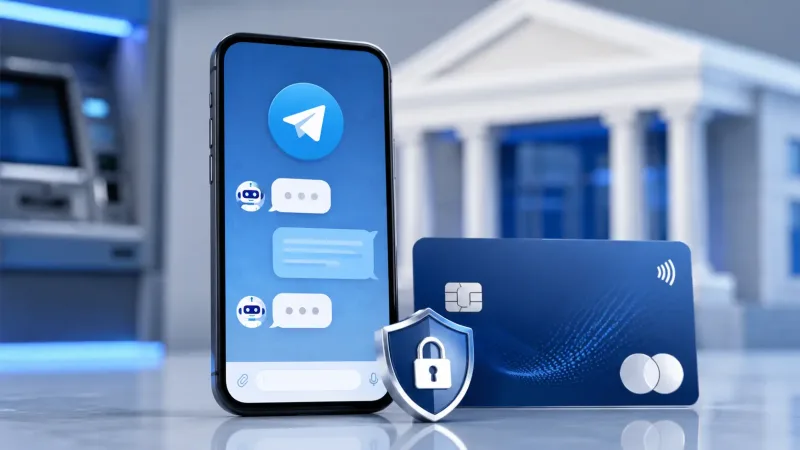
A banking Telegram bot is useful for general questions and access to bank-controlled services. Account data and transactions must follow the bank’s authentication, authorization and confirmation rules. Do not require customers to enter a PIN, CVV or one-time code into an ordinary Telegram chat.
A properly designed chatbot can handle all three safely. But there is one condition: Telegram must remain a controlled access point, not become the banking system itself. The bot can answer questions about products, show an application's status, display masked balances and transactions, and accept a request to block a card. It can even initiate a payment or transfer. Final approval, however, must take place in a bank-controlled Telegram Mini App, mobile app, or secure web page.
There is one rule on which we do not compromise: the bot must never ask for a PIN, CVV, one-time verification code, full card number, or passport copy in the chat. Transaction rules, calculations, and audit records must remain on bank servers. If Telegram becomes unavailable, customers must be able to continue through the app, website, or contact center.
This table is a starting model for project review, not a security certification. The bank’s security and legal teams must assess the actual workflow.
| Stage | Acceptance criterion |
|---|---|
| Telegram chat | General questions and service links; no collection of secret banking credentials |
| Bank-controlled sign-in | The customer authenticates using the bank’s approved method |
| Bank backend/API | Authorization on every request; minimum bot privileges |
| Result display | Only necessary data; masking rules for balances and account details |
| Sensitive operation | Bank-controlled confirmation; repeated requests cannot duplicate an action |
| Failure or outage | Handoff to operator, app or website with protected context |
| Audit | Traceable operation status; no PIN, CVV or one-time codes in logs |
Test unauthorized accounts, expired sessions, duplicate submissions, cancellation and Telegram outages. Check personal-data requirements against the lex.uz source cited in the article and local security context against CERT-CBU.
With proper authentication and limited API permissions, the following tasks can be handled through chat.
01
Provides short, clear explanations of rates, fees, and service terms.
02
Shows the current stage of a loan or card application.
03
Displays balances and recent transactions in a limited, masked format.
04
Immediately submits a request to temporarily suspend a lost card.
05
Collects the necessary information and moves approval to a secure interface.
06
Routes complex or suspicious requests to the appropriate employee.
In practice, the most dangerous mistake is putting the entire process inside the chat. Conversations with a bot do not use the same end-to-end encryption as Telegram secret chats. That means the chat window cannot be a place where confidential credentials are accepted or stored.
In a sound architecture, the bot does nothing more than receive a command. The API validates the request, the bank server makes the decision, and the bot displays only the permitted response. For example, a card number appears as 8600 **** **** 4821. The full number is never sent to Telegram.
The Red Line If a customer is typing a one-time verification code, PIN, or CVV into the bot, the process was designed incorrectly from the start. A warning alone is not enough. The bot must be technically unable to accept this information.
Suppose a customer in Tashkent wants to transfer 12 mln soums through Telegram. The bot identifies the recipient and amount, then displays the fee. The customer is then moved to a bank-controlled Telegram Mini App or mobile app. There, the transaction is approved using biometrics or the app's PIN.
The response sent back to the bot is also brief: the status, time, and masked details. Telegram does not make the decision to debit the funds; the bank's risk assessment module does. If it detects a large amount, a new device, or an unusual recipient, the transaction is sent for additional review.
A good banking bot does not control the money. It guides the customer into a secure process controlled by the bank.
Celion engineering principle

Telegram should be a controlled storefront, not a vault for banking secrets.
Once the bot is live, it is too late to start asking this question. Which messages are stored? What is written to the audit log? When is the data deleted, and which employees can see it? Every answer must be documented in the technical specification.
The Law on Personal Data and the Central Bank's cybersecurity requirements do not allow organizations to retain unnecessary data without reason. The work of CERT-CBU also requires financial institutions to follow dedicated procedures for detecting and responding to incidents. Data received through the bot must be managed within bank-controlled infrastructure, with clearly defined retention periods and access permissions.
Start with low-risk services that customers request frequently. Leave money transfers for a later stage.

Chat can initiate a transfer, but final approval must happen within the bank's secure environment.
Telegram is a convenient customer communication channel in Uzbekistan. But being the closest channel does not mean it should be the only one. Telegram outages observed in Central Asia have shown exactly where a service that depends too heavily on an external platform can break.
Even when the bot is unavailable, customers must still be able to block a card, dispute a transaction, and access their account through the mobile app, website, or contact center. To combat fake bots, use the same official username across every channel. Links should lead only to verified domains. While completing a transaction, the customer should see a warning that says, "Our employees will never ask for your code."
A Practical Test If compromising the bot would allow an attacker to transfer money independently, the architecture is unacceptable. Taking over a Telegram account must not automatically grant access to the bank account.
Before launching a Telegram bot, include these five requirements in the technical specification.

A Telegram outage should never stop customer service or the bank's core processes.
Can a Telegram bot display a customer's balance?
Yes. The customer must first be verified using a method controlled by the bank. Balance privacy settings, short sessions, and device controls should be used. The bot must not automatically display the full balance or account details in a notification. Ideally, customers should be able to manage this in the settings.
Is it safe to transfer money through a bot?
The bot can initiate a transfer and calculate the fee. Final approval must take place not in a regular chat, but in a bank-controlled Mini App, mobile app, or secure web page. After the amount, device, and recipient pass through the risk assessment module, the bank server executes the transaction.
Are Telegram bot conversations secure enough?
Conversations with a bot do not use the end-to-end encryption available in secret chats. For this reason, customers must not send a PIN, CVV, one-time verification code, full card number, or passport copy through the chat. Even when transport encryption is in place, keeping confidential data out of the chat entirely is safer.
Where should data collected by the bot be stored?
Customer and transaction data must be stored within infrastructure controlled by the fintech or bank. The storage location, retention period, employee permissions, and audit procedures must be reviewed for compliance with Uzbekistan's laws and regulatory requirements. Using Telegram chat history as the primary data repository is a mistake.
How long does it take to launch this kind of bot?
A pilot limited to questions, answers, and application status can often be ready within a few weeks. Adding balances, card management, or transfers takes longer because of API integration, security testing, and legal review. The right approach is to launch a limited pilot first, then expand its functions based on monitoring results.
The Celion team develops Telegram bots, Telegram Mini Apps, bank API integrations, and secure approval processes for fintech companies. Discuss your idea with us. We will start not with a feature list, but by defining the risk boundary together.
Callback
Leave your details and we will contact you shortly.
Become a Partner
Leave your contact details and we will get back to you shortly.
Order Service
Leave your phone number and we will contact you shortly.