
 AI
AI What Is AI Implementation for Businesses in Uzbekistan?
AI implementation is not adding a chatbot. It is embedding intelligent agents into real business workflows - lead qualif...

It is Friday, 7:10 p.m. Orders are coming into a Tashkent store through Telegram, but the AI agent has gone silent. This is not the time to wait for the system to recover on its own. Within fifteen minutes, the customer may message another seller, while the operator can no longer tell which messages have been seen and which ones remain unanswered.
In a properly designed system, an agent outage does not bring sales to a halt. An inquiry from Telegram, Instagram, or the website is first written to a reliable queue. Only then does the agent process it. If the agent is unavailable, a fallback scenario informs the customer and transfers the conversation to an operator. Order, payment, and inventory data remains in the CRM, ERP, or database—not in the agent’s memory.
At Celion, we follow one rule: an AI agent delivers the service, but it must never be the business’s single point of dependency. If the queue, operator handoff, duplicate-request protection, and monitoring are built in advance, the order will remain safe even if the agent is down for an hour. The customer is not left without a response, and work continues once the system recovers.
We often see the same mistake in practice: the agent manages the conversation, collects the order, and stores its status in its own memory. At first, this looks fast and convenient. But as soon as the agent restarts or the model API stops responding, the conversation context disappears too.
The order number, phone number, product, amount, and payment status must be written immediately to a separate system. The agent reads that data and makes changes through a controlled API. This makes it possible to replace the agent, temporarily disable it, or hand the conversation over to an operator. The business data stays where it belongs.
“The agent is not working” is not a diagnosis. The fallback must behave differently depending on where the failure occurs.
01
If the response is delayed, the request remains in the queue or is handed over to an operator.
02
An incoming message is saved immediately and is not recorded twice if it is received again.
03
If the order is not written to the system, no confirmation is sent to the customer.
04
The payment result comes from the provider callback, not from text generated by the agent.
If the agent cannot respond, the system should not make speculative promises on behalf of a person. One clear message is enough: “Your request has been received. Our automated assistant is temporarily unavailable, and an operator will respond.” The inquiry enters the operator queue together with a timestamp, the selected language, and the conversation history.
The conversation language should not change during an outage either. If the customer writes in Uzbek, the fallback response is sent in Uzbek. An inquiry in Russian or English is answered in the same language. This is not about comparing languages. The point is to continue the conversation in the context in which the customer started it.
Warning
“The agent responded” and “the order was created” are not the same status. Do not tell the customer that the order has been accepted until confirmation arrives from the CRM or ERP.
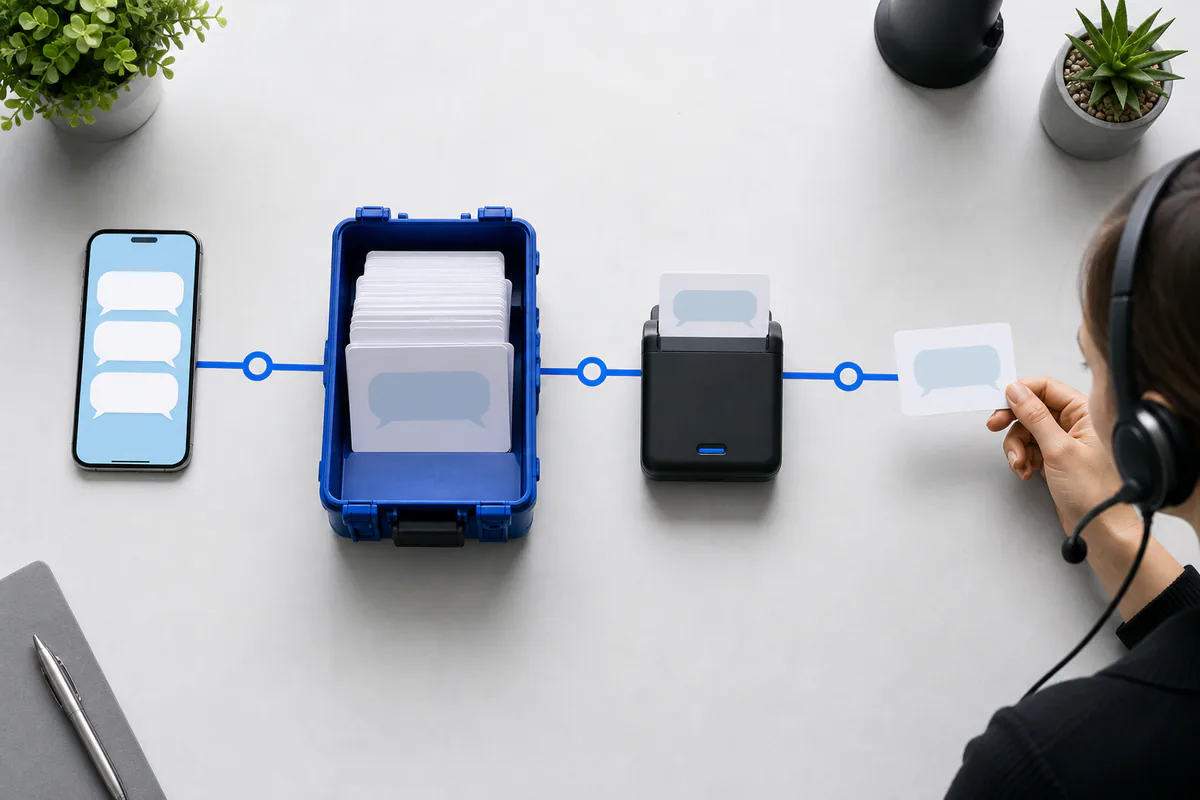
AI processes requests, while the reliable queue remains the source of truth.
It is risky to send a task to the agent as a one-time request. The task should first be written to a queue and then processed by a separate worker. An approach such as n8n’s queue mode makes it possible to connect multiple workers and retain tasks that could not be completed temporarily.
Retries must be protected. When the connection is restored, the same order must not be added to the CRM twice, and the customer’s card must not be charged twice. To prevent this, every operation receives a unique key. If the system sees that the key has already been processed, it does not repeat the operation.
We prepare this kind of system in five steps.

A brief fallback response and human handoff are better than complete silence.
A system interface opening successfully does not mean the system is working. Monitor response times and queue length. Errors and inquiries handed over to operators should also be counted separately. Prometheus can collect the metrics. Grafana displays the system’s status. OpenTelemetry helps identify where a specific order stopped on its journey from Telegram to the CRM.
Alert thresholds must also be defined clearly. There is no need to wake the night-shift engineer over a single error. But repeated failed requests or a rapidly growing queue should trigger an immediate Telegram alert to the responsible employee. Monitoring only the server processor is not enough. The system must also measure whether the order was created, the payment was recorded, and the customer received a response.
A good agent answers many questions. A well-designed system keeps the order safe even when the agent goes silent.
Celion engineering principle
Two instances hosted in the same data center and connected to the same network and database do not constitute a complete fallback. If a shared dependency fails, both instances stop working. It must be possible to restore a critical process in another location. Backups should be stored independently, and the recovery instructions must be tested in practice.
A retailer in Tashkent does not need to duplicate every component. Start by protecting against the costliest outage: incoming Telegram messages, confirmed orders, and payment results must be preserved. An advertising recommendation or an additional product suggestion can wait. The customer’s money and order cannot.

A second server is not enough without monitoring, independent links, and failover.
An agent outage should remain a technical issue. Do not let it become a sales outage.
Does a small business need this kind of fallback system too?
Yes, but the solution should match the business risk. For a small store, saving Telegram messages, sending a clear fallback response, and maintaining an operator queue may be enough. A business that accepts payments or receives hundreds of orders per day also needs protection against duplicate operations and proper monitoring. In that case, separate fallback infrastructure may be worth considering.
How can you quickly detect that the agent is down?
Sending a test request every minute is not enough. Monitor the model’s response time, completed tasks, errors, and queue length together. If a metric exceeds the defined threshold, the responsible employee should receive a Telegram alert. The fallback scenario should start automatically.
Should every queued message be processed at once when the agent recovers?
No. Sending every task at once creates a sudden load on the CRM, model API, or payment system. Process the queue at a controlled rate and by priority. Payments and active orders come first; general questions can wait. Every task must be protected against duplicate execution.
Where does the operator continue the customer conversation?
Ideally, inquiries from Telegram, Instagram, and the website should appear in a single operator interface. The operator must be able to see the language used by the customer and all previous messages. Actions performed by the agent and the order status should also appear there. That way, the customer does not have to repeat everything from the beginning.
How often should the fallback system be tested?
At least once every quarter and after every major update. During the test, disable the model API, CRM connection, and channel receiver separately. Do not stop at confirming that the system came back online. Check that no orders were lost or created twice.
The Celion team designs fallback architectures for Telegram-based service, order automation, and AI agents. First, we identify where the system could fail. Then we create a practical plan for operator handoff and recovery. Contact us to have your system assessed.
Callback
Leave your details and we will contact you shortly.
Become a Partner
Leave your contact details and we will get back to you shortly.
Order Service
Leave your phone number and we will contact you shortly.