 Business Automation
CRM Automation and Follow-Up for Sales Teams in Uzbekistan
A practical guide for Uzbek sales teams: how to eliminate manual entry, stop losing leads, and build automated follow-up...
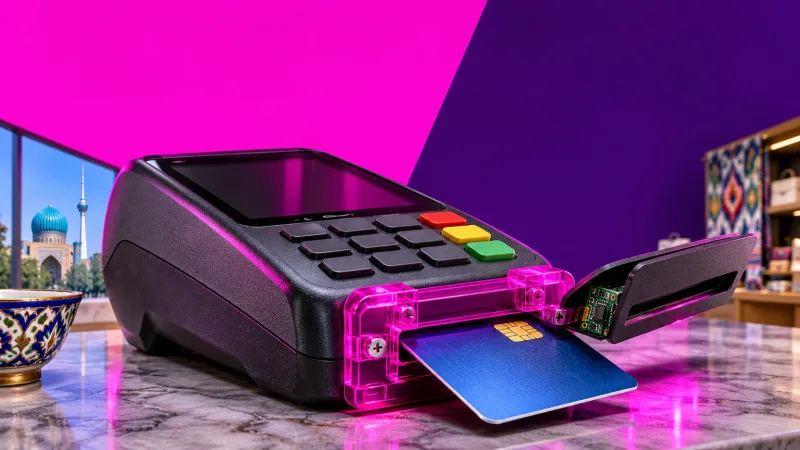
To reduce card fraud, do not let card data enter your systems. Route payments through a bank- or provider-hosted page, and decide in advance who must do what when a suspicious transaction is detected.
According to data on CardBlock published by Spot on 16 November 2026, citizens reported 278,3 bln soums in suspected card theft from the beginning of the year through 1 October, while transactions worth 113,1 bln soums were blocked. A rapid report can save funds. But bank-level protection does not secure a business’s own website or the payment dashboard used by its employees. Payment links sent through Telegram also remain under the business’s control.
CardBlock is neither a type of fraud nor a standard reporting website. It is an information exchange mechanism between the Central Bank and the Ministry of Internal Affairs. Once the account receiving suspicious funds is identified, the relevant information is transmitted quickly so restrictions can be imposed.
The issue is not limited to CardBlock reports. Central Bank statistics recorded 956 complaints related to “bank cards and fraud” from January through June 2026, compared with 245 during the same period in 2025. This is a broader category. Treating these figures as equivalent to CardBlock reports would be incorrect.
Regulation No. 3759-1, which took effect on 16 November 2026, requires biometric verification for remote registration, password recovery, and sign-ins from a new device. It also establishes requirements for matching a user’s identity with the registered phone subscriber and issuing warnings when malicious or remote-access software is detected. These controls apply to banking and payment apps. Businesses should not leave their own processes unchecked on the assumption that “the bank will verify everything.”
An online store may not store card data directly, yet risks can still emerge within its own processes. A payment button on the website can be replaced with a link to a fake address. A Telegram operator may send the wrong link, or an employee with dashboard access may change refund settings or account details.
Businesses often check the card form customers see while overlooking post-payment administration. Who can issue a refund? Who can add new account details? When is a former manager’s access revoked? Even if the payment page is secure, the dashboard remains the weak point if everyone uses a single shared password.
Many businesses send customers payment links through Telegram. Employees should never ask for a card number or verification code in the chat. Customers should proceed only to the company’s exact domain or a verified provider page. The operator should check payment status using the order identifier.
The “successful payment rate” does not provide a complete picture of security. Even when this metric remains high, disputed transactions, suspicious refunds, or unusual dashboard logins may be increasing. Alongside approved payments, managers need visibility into disputed amounts and the time it takes to report an incident to the bank.

The first check is simple: where does the card data pass through? If the full card number, expiration date, or security code reaches a company server—including its CRM system or an employee chat—you need to change the payment architecture, not the design.
Separate software is not always necessary. If you already use a provider-hosted payment page, have only a few employees, and allow only the owner to issue refunds, organizing the existing settings and access permissions may be enough to begin with.

Celion does not replace a bank’s anti-fraud system. It organizes the part that the business controls. The website or mobile app connects to a provider-hosted payment page, while payment status is recorded in the CRM or ERP system. Refund permissions are assigned by role, and an incident log is maintained.
For example, a Telegram operator does not manually send a card number to the customer. Instead, the operator generates a one-time order link from the CRM, and the payment result is automatically attached to the order. If the system detects an unusual refund, a change in account details, or a series of declined transactions, it sends an alert to the responsible manager through Telegram.
A project like this should begin with a payment map, not code. Where does the customer enter the flow? Which page do they proceed to? Which system stores the transaction identifier, and who acts first when an incident occurs? Without clear answers to these questions, a new module will only accelerate the existing disorder.
Celion’s payment integration and business process automation service connects the payment page to a CRM or ERP system. Access permissions are separated, while alerts and response procedures are configured for signs of fraud.
Callback
Leave your details and we will contact you shortly.
Become a Partner
Leave your contact details and we will get back to you shortly.
Order Service
Leave your phone number and we will contact you shortly.